15 Thanksgiving Math Activities for Kids
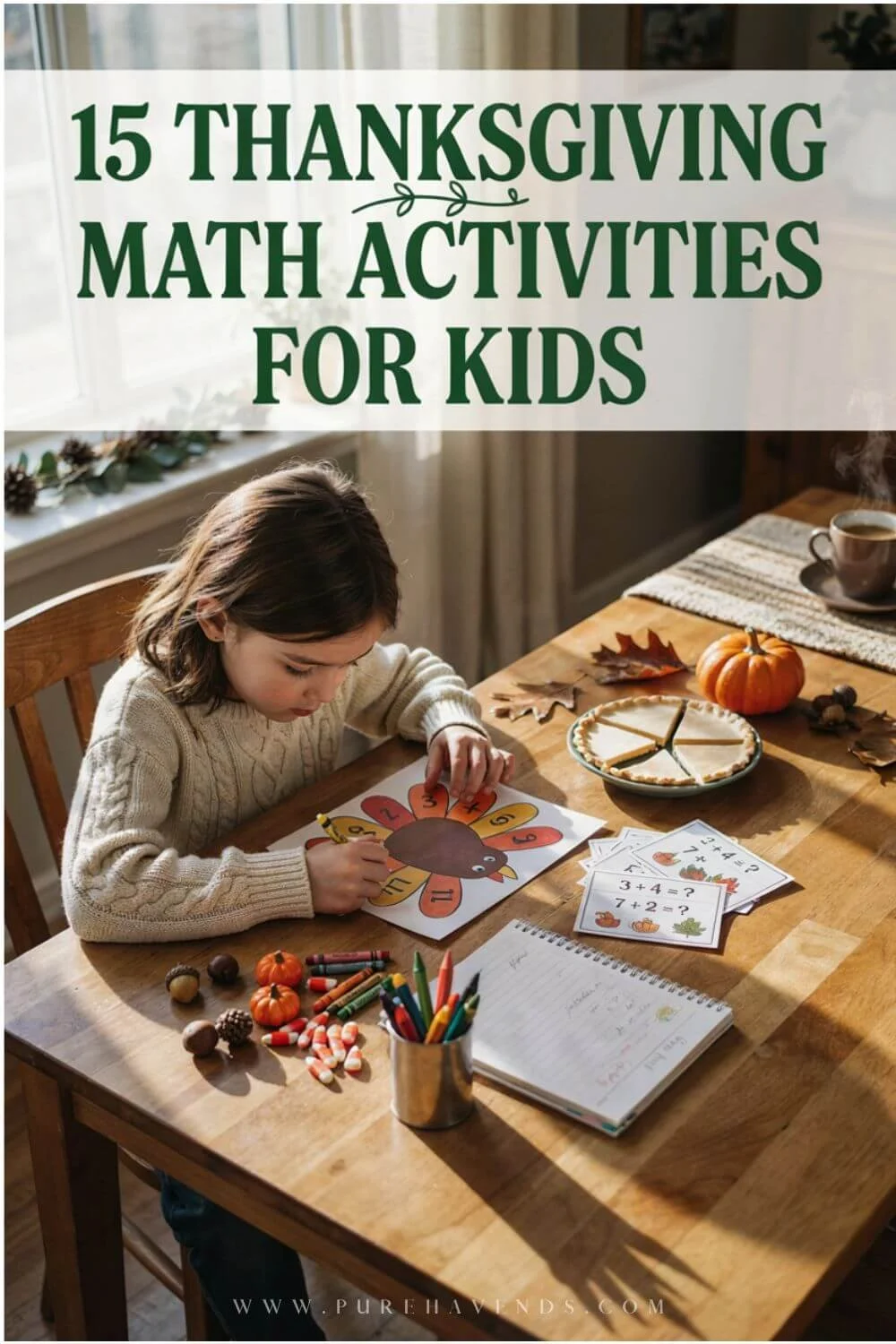
Thanksgiving math activities are a fun way to keep kids learning while getting into the holiday spirit. From counting and addition to fractions, graphing, and real-life problem-solving, these activities make math feel less like a lesson and more like play.
Whether you're homeschooling or simply looking for an educational activity to do together over Thanksgiving, these 15 ideas are simple, hands-on, and easy to set up at home. 🦃🍂
Disclosure: This post contains affiliate links that are at no additional cost to you, I may earn a small commission. All Products are linked in Blue.
1. Turkey Feather Counting Activity
Turn counting practice into a fun Thanksgiving activity by creating a turkey with colorful paper feathers. This is a simple activity for younger learners who are working on number recognition, counting, and one-to-one correspondence.
How to Do It
Start by creating a simple turkey body using construction paper. Make several colorful feathers and write a number on each one.
Have your child choose a feather and identify the number. Then, they can place the correct number of counters on the feather or around the turkey.
For example, if the feather says 8, your child should count out eight pom-poms or other small manipulatives.
Once they're comfortable with the activity, turn it into a quick math game by calling out a number and having your child find the matching feather.
💡 Make It Easier or Harder
For younger children: Start with numbers 1–10 and focus on counting objects.
For older children: Use larger numbers or have them practice addition by combining two feathers. For example, if one feather has 5 and another has 4, ask, "How many feathers do we have altogether?"
This is such a fun way to make math practice feel hands-on and festive without requiring a complicated setup.
🛒 What You'll Need:
Number cardsor a printable turkey template
2. Thanksgiving Addition with Counting Cards
Turn basic addition practice into a Thanksgiving-themed math game using simple counting cards. This activity is perfect for helping kids practice addition facts, counting, and number recognition while keeping the lesson hands-on.
How to Do It
Create several Thanksgiving-themed cards with simple addition problems. You can draw turkeys, pumpkins, leaves, or pies on the cards to make them more engaging.
For example:
3 + 2 = ?
Have your child use the counting manipulatives to represent both numbers. They can count out 3 objects, then add 2 more and count the total.
Once your child understands the concept, encourage them to solve the problems without the manipulatives and use them only when they need extra help.
💡 Make It Easier or Harder
For younger children: Use numbers 1–5 and let them physically count the objects.
For older children: Increase the numbers or create two-step Thanksgiving word problems.
For example:
"There are 6 pumpkins on the table. Mom adds 4 more. How many pumpkins are there now?"
You can also have your child create their own Thanksgiving addition problems for you to solve.
Hands-on counting makes addition easier for young learners to visualize, and adding a Thanksgiving theme can make practicing those math facts feel much more fun.
🛒 What You'll Need
Small counting manipulatives, such as pom-poms, buttons, or mini erasers
Blank Index Cardor homemade Thanksgiving-themed cards
3. Thanksgiving Subtraction with Turkey Feathers
Make subtraction a little more fun by using a turkey and its feathers as hands-on math manipulatives. This activity helps kids practice subtraction, counting backward, and understanding that taking away means there are fewer objects left.
How to Do It
Create a simple paper turkey and attach several removable feathers. Start by giving your child a subtraction problem.
For example:
9 − 3 = ?
Have your child start with 9 feathers on the turkey. Then ask them to remove 3 feathers and count how many are left.
You can make the activity more interactive by telling a simple Thanksgiving story:
"Our turkey has 9 feathers, but 3 blew away in the wind. How many feathers does the turkey have left?"
Continue with different subtraction problems, allowing your child to physically remove the feathers each time.
💡 Make It Easier or Harder
For younger children: Start with numbers up to 10 and let them physically count and remove each feather.
For older children: Use larger numbers or introduce two-step problems.
For example:
"The turkey had 12 feathers. It lost 4, then lost 2 more. How many feathers are left?"
You can also have your child write the subtraction equation that matches each turkey story.
Hands-on subtraction gives kids a visual way to understand what "taking away" actually means, making this a great activity for early elementary math practice.
🛒 What You'll Need
A paper turkey or turkey printable
4. Thanksgiving Word Problems
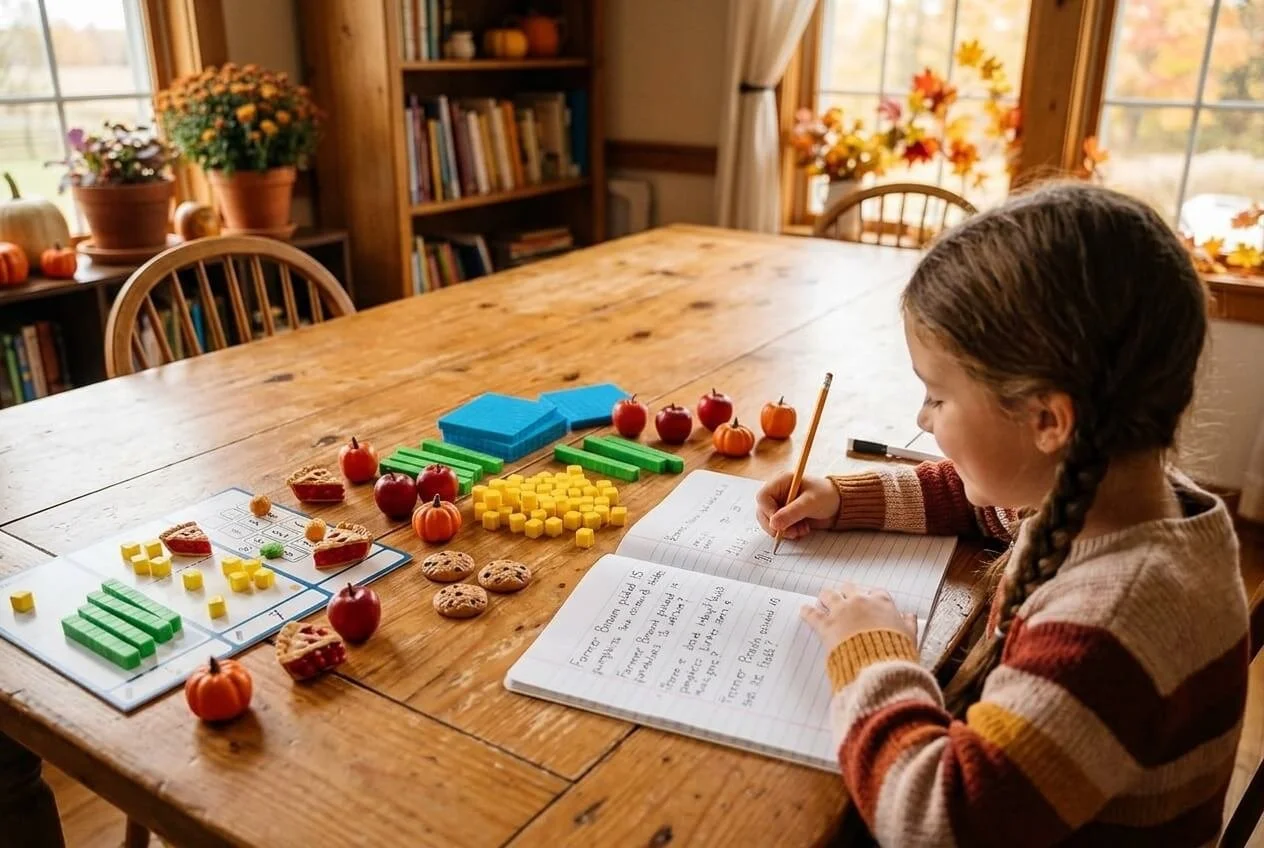
Turn everyday Thanksgiving situations into simple math word problems. This activity helps kids practice addition, subtraction, multiplication, or division while learning how math can be used in real-life situations.
How to Do It
Create a few Thanksgiving-themed word problems based on situations your child can imagine.
For example:
"There are 5 apples on the table. Mom puts 4 more apples in the bowl. How many apples are there altogether?"
Your child can draw the apples, use manipulatives, or write an equation to solve the problem.
You can also create problems involving Thanksgiving foods:
"There are 12 cookies. Four children each eat 2 cookies. How many cookies are left?"
Encourage your child to identify the important numbers, decide which math operation they need, and explain how they found the answer.
💡 Make It Easier or Harder
For younger children: Use simple addition and subtraction problems with numbers up to 10. Let them draw pictures or use counters to find the answer.
For older children: Introduce multiplication, division, fractions, or multi-step problems.
You can even let your child write their own Thanksgiving word problems for someone else in the family to solve.
Word problems are a great way to move beyond memorizing math facts and help kids understand how math can be used in everyday situations. And when the problems involve turkeys, pies, apples, and Thanksgiving dinner, it makes practice a little more exciting. 🦃🥧
🛒 What You'll Need
Thanksgiving-themed math problem cards or homemade cards
Small counting manipulatives for younger learners
5. Thanksgiving Graphing Activity
Turn your child's favorite Thanksgiving foods into a simple math graphing activity! This is a fun way to practice counting, organizing information, and reading data while using a theme kids already enjoy.
How to Do It
Start by choosing 4–5 Thanksgiving foods, such as:
🥧 Pie
🦃 Turkey
🌽 Corn
🥔 Mashed potatoes
🍎 Apples
Ask your child which foods they like best and record their answers. You can also have family members participate to create a larger data set.
Next, have your child create a simple bar graph showing the results.
For example:
Favorite Thanksgiving Foods
Pie: ⭐⭐⭐⭐⭐
Turkey: ⭐⭐⭐
Corn: ⭐⭐
Mashed Potatoes: ⭐⭐⭐⭐
Once the graph is complete, ask questions such as:
Which food received the most votes?
Which received the fewest?
How many people chose turkey?
How many more people chose pie than corn?
How many votes were there altogether?
💡 Make It Easier or Harder
For younger children: Use stickers or pictures instead of having them draw a traditional graph. Focus on counting and comparing more versus less.
For older children: Have them create a scaled bar graph, calculate the difference between categories, or write a few sentences explaining what the data shows.
This activity is a great reminder that math doesn't always have to happen in a workbook. Kids can practice collecting, organizing, and interpreting data using something as simple as their family's favorite Thanksgiving foods. 🥧📊
🛒 What You'll Need
Graph paper or regular paper
Pencil
Crayons or colored pencils
Clipboard
Thanksgiving food picture cards or a simple homemade food list
Optional: Thanksgiving-themed stickers
6. Thanksgiving Fractions with Pie
Turning desert into a fractions activity! Using a paper pie or a real pie, kids can practice identifying whole, halves, thirds, fourths, and other fractions in a way that's easy to visualize.
How to Do It
Start by drawing a large circle on a paper plate to represent a Thanksgiving pie. Divide the circle into equal sections.
Begin with simple fractions:
1 whole pie = 1
Cut it in half:
1 out of 2 pieces = 1/2
Then divide it into four equal pieces:
1 out of 4 pieces = 1/4
Have your child color different sections and identify the fraction represented.
For example, ask:
"If we have 4 equal pieces and you color 3 of them, what fraction of the pie is colored?"
Your child should be able to see that 3 out of 4 pieces = 3/4.
You can also practice adding and comparing fractions once your child is ready.
💡 Make It Easier or Harder
For younger children: Focus on whole, half, and fourths. Have them physically cut or color the paper pie.
For older children: Practice equivalent fractions, comparing fractions, or adding fractions with common denominators.
You can even turn it into a real-life Thanksgiving math problem:
"Grandma made one pie and cut it into 8 equal slices. Your family ate 3 slices. What fraction of the pie is left?"
Using something familiar like pie makes fractions much easier for children to visualize. Plus, it gives you a fun opportunity to connect math to a real Thanksgiving tradition. 🥧
🛒 What You'll Need
Paper plates or cardstock
Child safe Scissors
Crayons or Washable markers
Ruler
Optional: a real pie or pizza to make the lesson more hands-on
7. Thanksgiving Measurement Activity
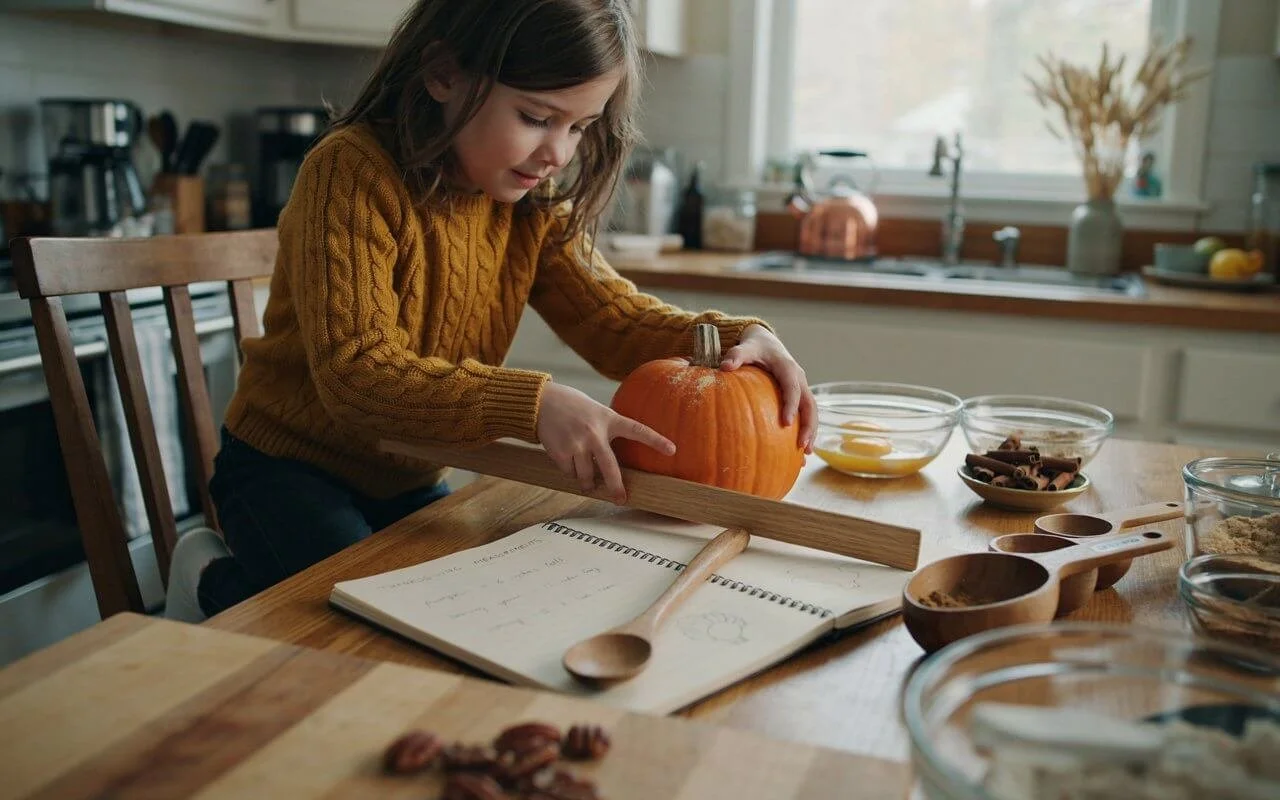
Turn your Thanksgiving kitchen into a mini math lab! Measurement activities are a great way for kids to practice using rulers, measuring cups, and other tools while learning how math is used in everyday life.
How to Do It
Start by giving your child several objects to measure. You could measure a pumpkin, a spoon, a serving dish, or even the length of a Thanksgiving table.
Have your child record each measurement in their notebook.
For example:
How long is the serving spoon?
Prediction: 8 inches
Actual measurement: 10 inches
You can also bring measurement into the kitchen by having your child help measure ingredients for a simple Thanksgiving recipe.
Ask questions such as:
Which object is the longest?
Which is the shortest?
How much longer is one object than another?
How many cups of an ingredient does the recipe need?
How many tablespoons are in a certain number of teaspoons?
💡 Make It Easier or Harder
For younger children: Focus on comparing objects using words like longer, shorter, heavier, and lighter. You can also practice measuring objects with a ruler to the nearest inch.
For older children: Practice converting measurements, doubling or halving recipes, or calculating how much of each ingredient would be needed to serve more people.
Cooking and measuring are a wonderful way to show kids that math isn't just something they do during homeschool lessons. It's a skill they can use in the kitchen, around the house, and in everyday life. 🥧📏
🛒 What You'll Need
Measuring cups and spoons
Ruler
Paper or a math notebook
Pencil
A few Thanksgiving-themed objects to measure
Optional: ingredients for a simple recipe
8. Thanksgiving Grocery Store Math
Turn a pretend grocery trip into a fun Thanksgiving math activity! This activity gives kids a chance to practice addition, subtraction, money, budgeting, and decision-making using a Thanksgiving dinner theme.
How to Do It
Create a pretend Thanksgiving grocery store using pictures or items you already have around the house. Give each item a price.
For example:
🥧 Pie — $6
🌽 Corn — $2
🥔 Potatoes — $4
🍎 Apples — $3
🦃 Turkey — $15
Give your child a pretend budget, such as $30, and challenge them to create a Thanksgiving shopping list without going over budget.
Have them add the prices of their items and determine how much money they have left.
You can also introduce simple scenarios:
"You have $25 to spend. You buy a pie for $6 and potatoes for $4. How much money do you have left?"
💡 Make It Easier or Harder
For younger children: Use whole-dollar prices and let them use play money or manipulatives to count their purchases.
For older children: Introduce decimals, sales, discounts, tax, or percentage calculations. You can even challenge them to plan a Thanksgiving meal for a specific number of people while staying within a set budget.
This is a great way to connect math to a real-life skill. Kids aren't just solving equations—they're learning how to make choices, compare prices, and manage a budget. 💰🦃
🛒 What You'll Need
Paper or a notebook
Pencil
Dry-erase board
Play money
Calculator (optional)
Grocery store flyers or printed pictures of Thanksgiving foods
Small basket or reusable shopping bag
9. Turkey Place Value Activity
Make place value practice more festive with a simple turkey activity! This is a fun way for kids to practice ones, tens, hundreds, and even thousands while working with Thanksgiving-themed numbers.
How to Do It
Create a paper turkey with several feathers. Write different numbers on the leaves and have your child identify the value of each digit.
For example:
347
Ask your child:
What digit is in the ones place?
What digit is in the tens place?
What digit is in the hundreds place?
What is the value of the 4?
You can also turn the leaves into a place value game. Write individual digits on each leaf and have your child arrange them to create different numbers.
For example, using 2, 5, and 8, challenge them to create the largest number they can.
Then ask:
"Can you rearrange the leaves to make the smallest number?"
💡 Make It Easier or Harder
For younger children: Start with two-digit numbers and focus on ones and tens.
For older children: Use three- or four-digit numbers and introduce expanded form.
For example:
347 = 300 + 40 + 7
You can also have your child compare two numbers and use <, >, or = to determine which is greater.
Turning place value into a turkey-themed game gives kids a visual and hands-on way to practice an important math skill while keeping your Thanksgiving homeschool lesson fun. 🦃🔢
🛒 What You'll Need
Construction paper or cardstock
Scissors
Markers or crayons
Place value chart
Small number cards
Optional: base-ten blocks or other math manipulatives
10. Thanksgiving Skip Counting Activity
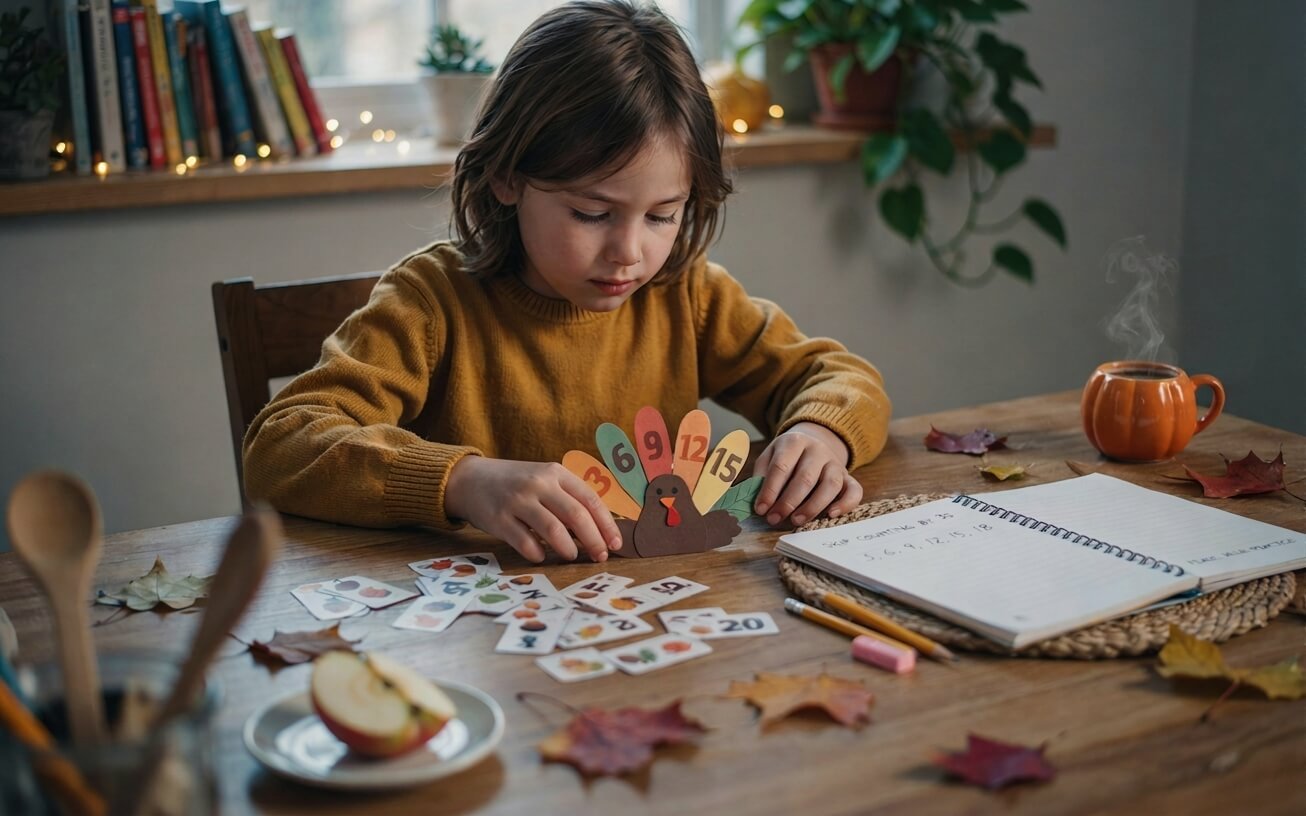
Make skip counting more engaging with a Thanksgiving-themed activity! This is a simple way for kids to practice counting by 2s, 5s, 10s, or other number patterns while working with turkeys, pumpkins, leaves, or other fall-themed objects.
How to Do It
Create a set of Thanksgiving-themed cards with numbers that follow a skip-counting pattern.
For example, for counting by 5s:
5 → 10 → 15 → 20 → 25 → 30
You can write each number on a turkey feather, pumpkin, or leaf and mix up the cards.
Have your child put the cards in the correct order. Then, have them continue the pattern by creating the next few numbers.
You can also make the activity more hands-on by having your child place 5 counters next to each number as they count.
💡 Make It Easier or Harder
For younger children: Start with counting by 2s, 5s, or 10s using numbers they already recognize.
For older children: Practice counting by 3s, 4s, or larger numbers. You can also give them a missing number and ask them to figure out what belongs in the sequence.
For example:
10 → 20 → ___ → 40 → 50
Ask:
"What number is missing?"
You can also challenge your child to create their own Thanksgiving skip-counting pattern for you to solve.
Skip counting is an important foundation for multiplication, so turning it into a playful Thanksgiving activity gives kids extra practice without making it feel like repetitive drill work. 🦃🔢
🛒 What You'll Need
Construction paper or cardstock
Washable Markers or crayons
Number cards
Small counting manipulatives
Optional: Thanksgiving-themed stickers
11. Thanksgiving Multiplication with Turkey Groups
Turn multiplication practice into a hands-on Thanksgiving activity by creating groups of turkeys, pumpkins, or other fall-themed objects. This helps kids understand multiplication as equal groups and repeated addition.
How to Do It
Start by creating several groups of Thanksgiving-themed objects. For example, you could make 4 groups with 3 turkeys in each group.
Ask your child:
"How many turkeys do we have altogether?"
Have them count the groups:
3 + 3 + 3 + 3 = 12
Then introduce the multiplication equation:
4 × 3 = 12
Continue with different combinations, such as:
2 groups of 5
3 groups of 4
5 groups of 2
4 groups of 5
Encourage your child to draw their own Thanksgiving groups and write the matching multiplication equation.
💡 Make It Easier or Harder
For younger children: Focus on equal groups and repeated addition before introducing the multiplication symbol.
For older children: Use larger numbers, introduce multiplication word problems, or have them create their own Thanksgiving multiplication challenges.
For example:
"There are 6 plates with 4 cookies on each plate. How many cookies are there altogether?"
Using objects your child can physically move and group helps make multiplication more concrete. Once they understand the idea of equal groups, the multiplication equation becomes much easier to understand. 🦃✖️
🛒 What You'll Need
Construction paper or cardstock
Scissors
Washable Markers or crayons
Small counting manipulatives
Multiplication number cards
Optional: Thanksgiving-themed stickers
12. Thanksgiving Math Scavenger Hunt
Take your math lesson around the house with a Thanksgiving-themed math scavenger hunt! This activity gets kids moving while practicing counting, addition, subtraction, shapes, measurement, and other math skills.
How to Do It
Create a list of Thanksgiving-themed math challenges for your child to complete around the house.
For example:
Find 5 objects that are orange.
Find something that is longer than 10 inches.
Find 3 objects shaped like a circle.
Count how many chairs are around your table.
Find two objects and determine which is heavier.
Find an object with a pattern.
Count how many spoons you have in the kitchen.
Have your child record their answers on a clipboard as they work through the challenges.
You can also add simple math problems between each challenge:
"Find 6 objects. Now find 4 more. How many did you find altogether?"
💡 Make It Easier or Harder
For younger children: Focus on counting, colors, shapes, and simple comparisons.
For older children: Add multiplication, measurement, fractions, estimation, or multi-step challenges.
For example:
"Find 3 groups of 4 objects. How many objects did you find altogether?"
You can also give your child a time limit and turn the activity into a friendly family competition.
A math scavenger hunt is a great way to break up the homeschool day and remind kids that math is all around them, not just inside a workbook. 🍂🔎
🛒 What You'll Need
Paper or a clipboard
Pencil
Dry Erase board
Thanksgiving math scavenger hunt cards or a homemade list
Measuring tape or ruler
Optional: small basket for collecting safe objects
13. Thanksgiving Budgeting Activity
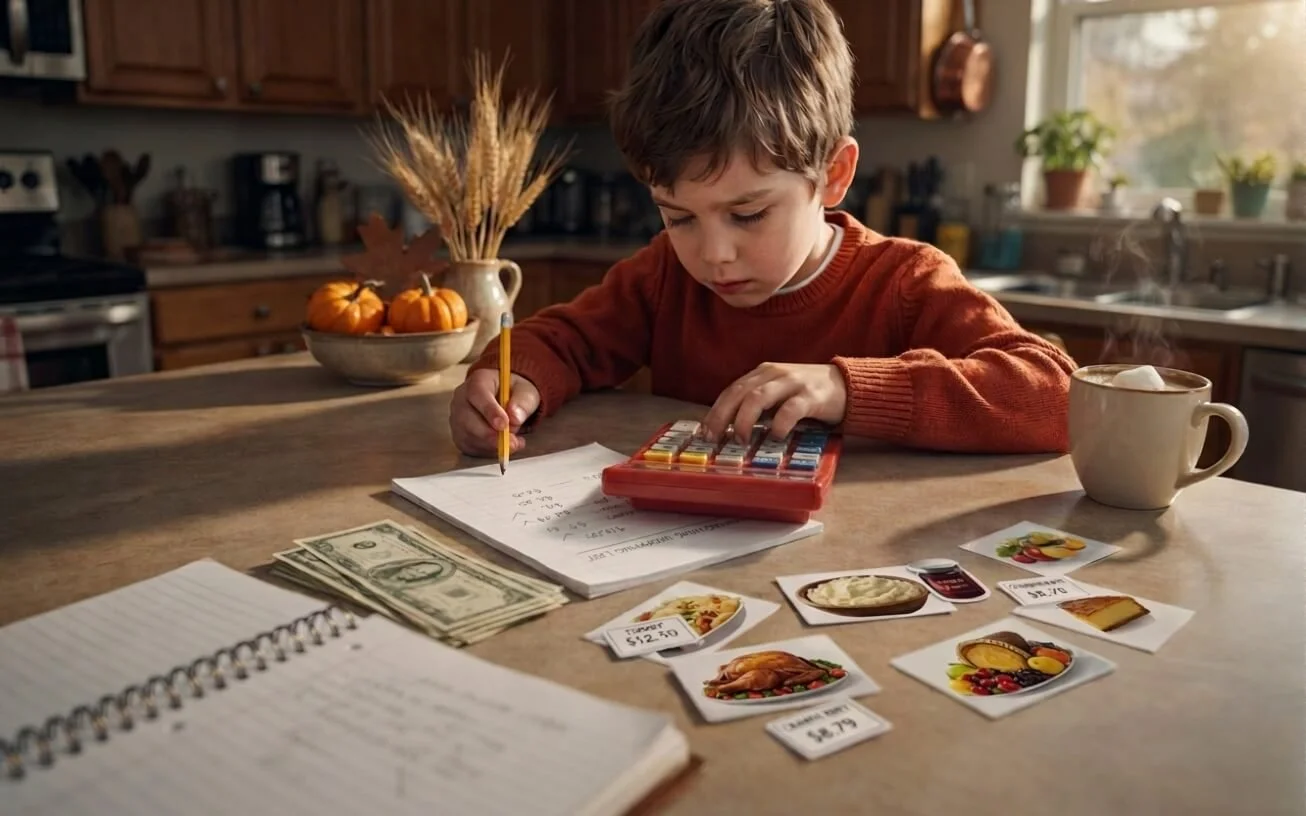
Turn Thanksgiving dinner planning into a real-life math and budgeting activity! This is a great way for older kids to practice addition, subtraction, money, decimals, and decision-making while planning a pretend Thanksgiving meal.
How to Do It
Give your child a pretend Thanksgiving budget. For example, tell them they have $50 to plan a simple Thanksgiving meal.
Create a list of foods they can choose from and give each item a price:
🦃 Turkey — $18
🥔 Potatoes — $4
🌽 Corn — $3
🥧 Pie — $6
🥖 Rolls — $3
🍎 Apples — $4
Have your child choose the items they want and calculate the total cost.
Then ask questions such as:
Did you stay within your $50 budget?
How much money do you have left?
Which item costs the most?
Which item costs the least?
What could you remove if you went over budget?
Can you create a second meal that costs less?
For older children, you can make the activity more realistic by introducing sales, discounts, tax, or price comparisons.
💡 Make It Easier or Harder
For younger children: Use whole-dollar amounts and keep the budget small. Let them use play money to physically represent their purchases.
For older children: Add decimals, percentages, sales tax, coupons, or a larger grocery list. You can even challenge them to plan a meal for a specific number of people while staying within their budget.
This activity is a great opportunity to teach kids that math isn't just something they use for school. Learning how to work with money, make choices, and stay within a budget are important life skills they'll use long after Thanksgiving is over. 💰🦃
🛒 What You'll Need
Paper or a notebook
Pencil
Calculator
Clipboard
Grocery store flyers or printed food prices
Play money (optional)
Reusable shopping bag or basket
14. Thanksgiving Math With Patterns
Patterns are an important early math skill, and Thanksgiving gives you an easy way to make pattern practice more fun. Use turkeys, leaves, pumpkins, or other fall-themed objects to create simple AB, AAB, ABC, and more advanced patterns.
How to Do It
Start by creating a simple pattern using Thanksgiving-themed objects.
For example:
🦃 🍂 🦃 🍂 🦃 🍂
Ask your child:
"What comes next?"
Once they understand the pattern, try a slightly more challenging one:
🎃 🍂 🍁 🎃 🍂 🍁 ___
Your child should identify the repeating sequence and determine what comes next.
You can also have your child create their own Thanksgiving patterns for you to solve. This encourages them to think about the pattern rather than simply recognizing one.
💡 Make It Easier or Harder
For younger children: Start with simple AB patterns using two different objects or colors.
For older children: Try more complex patterns such as AAB, ABB, ABC, or patterns involving numbers.
For example:
2, 4, 6, 8, ___
Ask your child to identify the rule and determine the next number.
Pattern activities help children develop logical thinking and recognize relationships between numbers, shapes, colors, and objects. Adding a Thanksgiving theme makes this important math skill feel more playful and seasonal. 🦃🍂
🛒 What You'll Need
Construction paper or cardstock
Scissors
Crayons or markers
Pattern blocks or patter cards
Thanksgiving-themed stickers or small manipulatives
15. Thanksgiving Math Game
Finish your list of Thanksgiving math activities with a simple math game the whole family can enjoy! Games are a great way to review skills your child has already practiced while keeping learning fun and low-pressure.
How to Do It
Create a simple Thanksgiving game board by drawing spaces from Start to Finish. Decorate the spaces with turkeys, pumpkins, leaves, or other Thanksgiving images.
On each turn, your child rolls the dice and moves their counter.
Add a math challenge to certain spaces. For example:
🦃 Turkey Space: Solve an addition problem.
🍂 Leaf Space: Count backward by 2s.
🥧 Pie Space: Solve a fraction question.
🎃 Pumpkin Space: Name the value of a digit.
🌽 Corn Space: Solve a multiplication problem.
If your child answers correctly, they stay on the space. If they need help, work through the problem together before continuing.
💡 Make It Easier or Harder
For younger children: Use simple counting, addition, subtraction, colors, and shapes.
For older children: Add multiplication, division, fractions, word problems, or multi-step equations.
You can also let your child create the game themselves. Have them design the board, write the math questions, and choose the rules. This adds an extra layer of learning while giving them ownership of the activity.
The best part of using math games in your homeschool is that your child can practice important skills without feeling like they're doing another worksheet. Sometimes a little competition, creativity, and Thanksgiving fun is all you need to make math more enjoyable. 🦃🎲
🛒 What You'll Need
Dice
Construction paper or cardstock
Pencil or markers
Small Thanksgiving-themed counters or manipulatives
Optional: small prizes or stickers
Make Math Part of Your Thanksgiving Homeschool
I hope these Thanksgiving math activities give you plenty of fun ways to keep learning going throughout the holiday season. From counting turkey feathers and practicing fractions with pie to budgeting for Thanksgiving dinner, these activities show kids that math can be found in everyday life.
You don't have to complete all 15 activities. Pick a few that match your child's age, interests, and current math skills, and make them your own.
if your child loves one of these activities, save it and bring it back next Thanksgiving! 🍂
📌 Save for Later
Looking for more seasonal homeschool ideas? Check out my 10 Simple November Homeschool Activities for Kids for more fun fall crafts, learning activities, and hands-on ideas you can add to your homeschool routine.
Save this post to Pinterest so you can come back to these Thanksgiving math activities whenever you need an easy holiday learning idea! 🦃📚