How to Teach Spanish at Home for Kids (Even If You Don’t Speak It)
If you’ve ever thought about teaching your kids Spanish at home but immediately stopped yourself because you don’t speak Spanish, no need to worry!
Here’s the truth most people don’t talk about, you do not need to be fluent or even close in order to teach your kids Spanish at home.
Teaching Spanish at home doesn’t have to look like formal lessons, perfect pronunciation, or hours of extra planning. For busy moms, especially those homeschooling or working from home, the easiest way to start is with simple Spanish words, short routines, and kid-friendly tools that do the teaching for you.
Let’s get into how to teach Spanish at home for kids, beginner-friendly strategies, the best tools and apps, and simple routines that actually work in real life.
No overwhelm. No pressure. Just small, doable steps that help your kids start learning Spanish in a fun and natural way. If you’ve been waiting for permission to start, this is it.
Can You Teach Spanish at Home Without Speaking It?
Short answer? Yes 100%. Let me say this clearly, because it’s the biggest mindset shift most moms need: You don’t have to “know” Spanish in order to help your kids learn Spanish.
Most kids don’t learn language the way adults do. They learn through repetition, songs, visuals, simple Spanish words, and daily exposure not grammar rules or long explanations. That’s actually why teaching Spanish at home can be easier than you think, even for complete beginners.
Think about how your child learned English. You didn’t sit them down with a textbook or explain sentence structure. You pointed to things, repeated words, sang songs, read books, and let them absorb it naturally. Learning Spanish works the exact same way.
Today, there are so many tools designed specifically for learn Spanish for beginners, especially for kids.
Your role isn’t to be an expert. Your role is to:
Create a small, consistent routine
Introduce simple Spanish words
Encourage practice without pressure
And honestly? That’s more than enough.
Starting with just 10 minutes, pressing play on a sing-along, reading alongside your child, or practicing a few words together is the beginning of their bilingual journey. Teaching Spanish at home doesn’t require perfection; it just requires showing up in small, doable ways.
The Easiest Way for Kids to Learn Spanish at Home
If there’s one thing that makes teaching Spanish at home feel manageable (instead of overwhelming), it’s this:
Simple, short, and consistent always wins.
You don’t need hour-long lessons or complicated plans. In fact, the easiest way for kids to learn Spanish is by incorporating it into their daily lives in small, repeatable moments, especially when they’re young.
Here’s what actually works for busy moms and homeschool families:
Start With Everyday Spanish Words
Begin with words your child already understands in English:
Colors
Numbers
Animals
Family members
Common objects around the house
Learning simple Spanish words through repetition helps kids build confidence fast. They love recognizing words they’ve already “mastered,” and it keeps learning fun instead of frustrating.
Use Audio & Visual Learning (Let Tools Do the Teaching)
This is where many moms breathe a sigh of relief.
You don’t have to pronounce everything perfectly or explain grammar. The best apps to learn Spanish for kids, videos, and interactive resources handle pronunciation, listening, and modeling correct speech for you.
Your job becomes:
Press play
Follow along
Practice together
Perfect for moms who want to learn Spanish alongside their kids.
Keep Lessons Short (5–15 Minutes Is Plenty)
Kids learn languages best in short bursts. A quick Spanish song, a few flashcards, or a page from a workbook can be more effective than a long lesson.
Think:
Morning basket activity
After breakfast routine
Before quiet time
Little moments add up.
Make It Fun, Not Formal
Games, songs, coloring pages, and hands-on activities help kids associate Spanish with joy — not school stress.
When learning feels fun, kids are more likely to stay engaged and actually remember what they’re learning.
The goal isn’t fluency overnight.
The goal is consistent exposure that builds confidence, vocabulary, and curiosity over time.
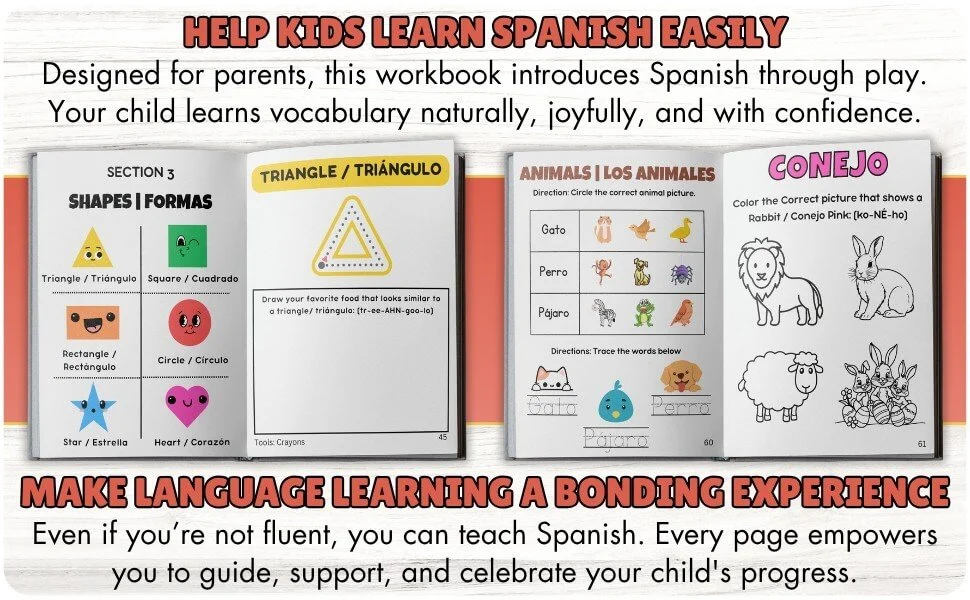
It’s a huge reason I decided to create My First Spanish workbook for kids, it's simple, interactive and goes over colors, number shapes, and more. Plus, you can find it on Amazon. Click here to take a look.
Best Apps to Learn Spanish for Kids
One of the easiest ways to help kids learn Spanish at home, especially if you don’t speak it yourself, is by letting apps do the heavy lifting.
The right app can teach pronunciation, reinforce Spanish words, and keep kids engaged… without adding more to your plate.
Here are some busy mom-approved options that work well for young learners and beginners:
Duolingo Kids (Great for Early Beginners) - Duolingo Kids is a gentle introduction to Spanish for children who are just starting out. Lessons are short, colorful, and game-based, making it perfect for quick daily practice. Best for: Ages 4–8 and kids learning Spanish for beginners
Gus on the Go (Vocabulary Made Fun - This app focuses heavily on vocabulary through games and repetition, like everyday Spanish words. Ideal for Preschool and early elementary learners
Little Pim (Video-Based Language Learning) - If your child learns best through visuals, Little Pim is a great option. It uses short videos to teach real-life Spanish vocabulary in context. It’s best for Visual learners and families who want low-effort learning
YouTube (Free & Surprisingly Effective) - You don’t need a paid app to start learning Spanish. There are amazing YouTube channels designed specifically for kids learning Spanish through songs, stories, and repetition.
A Quick Mom Reminder
Apps are tools, not a replacement for connection. I’ve learned that the best way for my kid to learn Spanish was when I sat beside him, when we repeated Spanish words together, and celebrated small wins. Remember, you don’t need to be fluent to be effective.
How to Learn Spanish With Your Kids (As a Busy Mom)
Let me say this first, you don’t need extra hours in your day to learn Spanish with your kids. You just need a rhythm that fits into the life you’re already living.
Most busy moms assume learning Spanish together means sitting down for long lessons, flashcards everywhere, and one more thing to prep. But in real life? That’s not sustainable and it’s exactly why moms burn out.
Here’s what actually works:
Learn Side-by-Side (Not Ahead of Them) - You don’t need to master Spanish before teaching it. When your child hears you practice Spanish words too, it feels safe and encouraging, creating a shared experience.
Keep Lessons Short (5–10 Minutes Is Enough). Spanish doesn’t need to be a “subject block.” A few minutes a day adds up, one song, one worksheet, or one app. Consistency matters far more than length.
Attach Spanish to What You’re Already Doing. This is where busy moms win. You can naturally practice Spanish during morning routines or snack time. Labeling objects, counting toys, and naming colors, throughout the day, makes learning feel effortless.
Use Done-For-You Resources (So You Don’t Have to Prep)This is a big one. As moms, we already carry enough mental load. Using ready-made Spanish resources means no lesson planning, no guessing what to teach next, and no stress about doing it “right.”
These printable worksheets or My First Spanish Workbook for kids, keeps learning Spanish simple and consistent without overwhelm.
Keep It Simple
You don’t need:
Perfect pronunciation
Long lessons
A bilingual home
You need:
Willingness
Consistency
Grace
Your kids don’t need perfection.
A Simple Spanish Learning Routine for Busy Moms
If you’re thinking, “This sounds great… but how do I actually fit this into our day?” I hear you. The goal isn’t to add more to your schedule. It’s to layer Spanish into what you’re already doing.
Here’s a simple, realistic routine that works for busy moms, homeschool families, and even moms learning Spanish after school.
Morning Routine (2–5 Minutes) - Start your day with light exposure, no sitting required. Play a short Spanish song during breakfast. Practice 3–5 Spanish words (colors, numbers, greetings). This sets the tone without demanding energy you don’t have yet.
Learning Time (5–10 Minutes) - This can happen during homeschool time, quiet time, or whenever your kids are already seated. Then you can choose between a page from a Spanish workbook, a short app lesson, or a printable Spanish worksheet.
Play-Based Practice (Optional, But Powerful) Spanish sticks best when kids don’t even realize they’re learning. Try going outside and naming colors in Spanish, counting snacks in Spanish, or matching Spanish words to pictures. Perfect for younger kids (ages 4–6) who learn best through play.
Wrap-Up (1–2 Minutes) - End the day casually by reviewing a few Spanish words, reading a short Spanish kids' book, or watching a short Spanish video together
The Secret to Making This Routine Stick
You don’t need to do all of this every day. Some days will be one song, one worksheet or one word. That's still progress, remember: Spanish learning works when it feels light, fun, and achievable.
Conclusion: You Can Help Your Kids Learn Spanish (Even If You’re a Beginner)
As a Latina homeschooling mama, who grew up with Spanish-speaking parents and did not speak Spanish until adulthood, I can tell you this:
You don’t need to be fluent, nor do you need a perfect accent or hours of extra time. You just need the willingness to learn Spanish alongside your kids.
Teaching Spanish at home isn’t about doing it “right, " it's about showing up in small, consistent ways. A few Spanish words here, a short song there, and a simple routine that fits your real life.
And the beautiful part? Your kids will see learning as something fun, normal, and shared.
Start small. Keep it light. Let it be joyful.
If you want extra support, don’t forget to:
Grab my FREE Spanish worksheets to get started right away.
Check out my Spanish workbook for kids (ages 4–6) on Amazon, designed to be fun, interactive, and easy for busy moms.
Save this post, pin it for later or share it with another mama who needs to read this!
You absolutely can do this and your kids are lucky to be learning from you.